
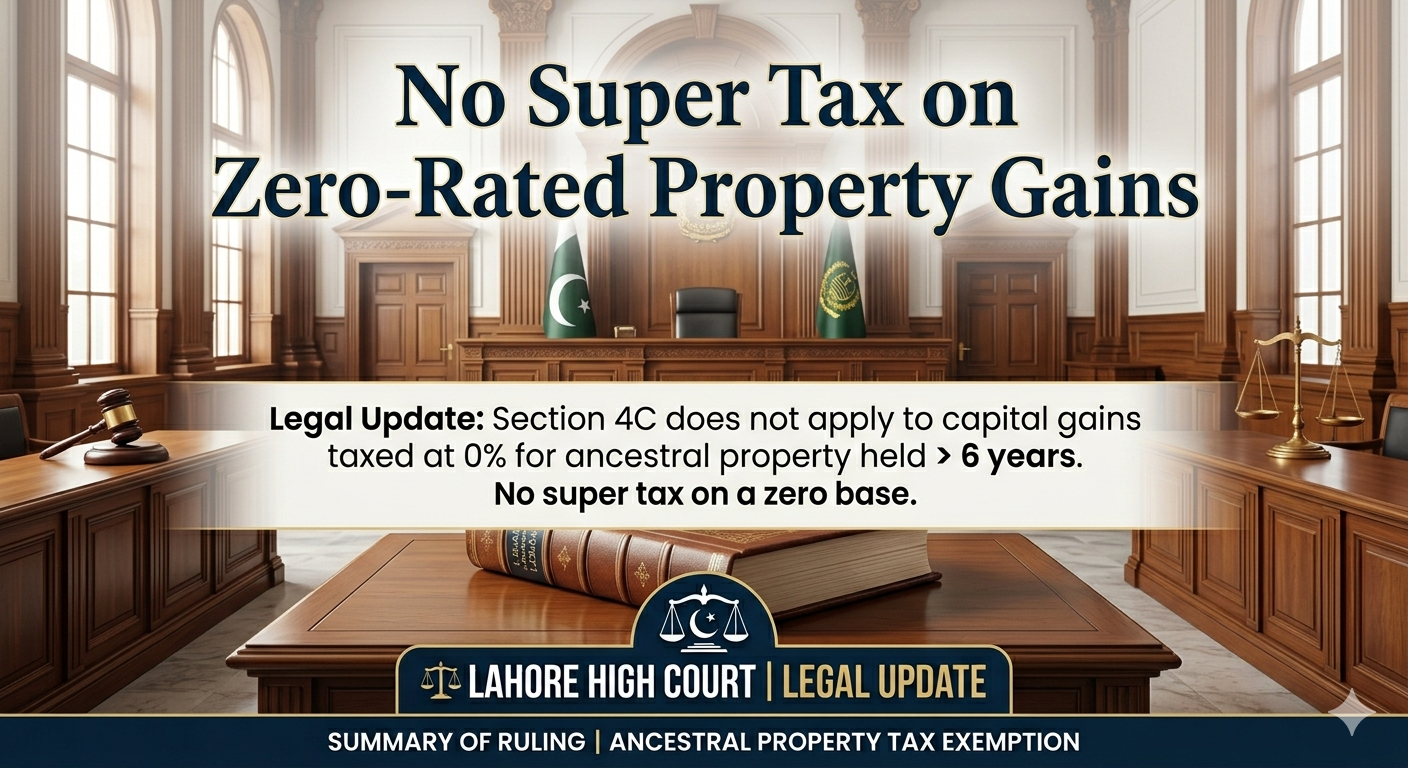
Super Tax Pakistan, Section 4C exemption, Capital Gains tax 0%, Lahore High Court judgment, ancestral property tax, Section 37(1A) Description: The Lahore High Court rules that Super Tax cannot be applied to capital gains from ancestral property held over six years, as a 0% tax rate leaves no base for supplementary levies.
Tax disputes often come down to one
simple question: can the government tax something they have already declared
tax-free? A recent decision by the Lahore High Court (LHC) in the case of Khairullah
Khan v. Appellate Tribunal Inland Revenue provides a clear answer for
property owners and corporate practitioners.
The Background Khairullah Khan sold the ancestral land he had held since
1980. Because he held the property for over six years, the law—specifically
Section 37(1A)—set his tax rate at 0%. However, tax authorities viewed his
massive gain of over 1.1 billion Rupees as "income". They issued a
demand for Super Tax under Section 4C, claiming he owed over 114 million
Rupees.
The Main Issue The core of the fight was whether Super Tax can exist on
its own. The FBR argued that because "capital gains" are listed as a
type of income in Section 4C, the Super Tax must be paid regardless of the
original tax rate. The taxpayer argued that if the primary tax is zero, you
cannot add a "super" tax on top of nothing.
What Both Sides Said The taxpayer’s team argued that Section 37(1A) is a special
rule that overrides general tax rules. Since the legislature chose a 0% rate
for long-held property, taxing it indirectly via Super Tax would go against
what lawmakers intended.
The FBR countered that Section 4C is
a "self-contained" charging provision. They believed it applies to
high-income earners, no matter where the money came from. To them, "0%
tax" is still "taxable income," just at a very low rate.
The Court’s Logic The LHC disagreed with the FBR. The judges relied heavily
on a landmark judgment from the Federal Constitutional Court of Pakistan (FCCP)
in the M/s DG Khan Cement case. The FCCP had already clarified that the Super
Tax is an "additional" tax.
The logic is simple: a supplement
cannot survive without a base. If the law says no tax is payable because a
property was held for a long time or was inherited, then Super Tax cannot be
triggered. The court noted that a 0% rate is legally the same as an exemption.
It creates a "nil tax value" that cannot be burdened further by
administrative interpretation.
Implications for Practitioners This judgment reinforces the principle that fiscal laws
must be read strictly. It stops the tax office from using Section 4C to
"backdoor" taxes onto income that the legislature intentionally
protected.
The Benefits This ruling provides massive relief for individuals selling long-held family land. It ensures that "zero-rated" actually means zero. For the wider business community, it sets a boundary: the FBR cannot use "Super Tax" to override specific exemptions or concessions granted elsewhere in the Income Tax Ordinance.
Copyright @ Taxationist. Designed By TechWare House